
 EN
EN Login
Login Donation

【Press Release】
January 6, 2026
Hong Kong Building Maintenance Bid-Rigging Study Reveals Deep-Seated Crisis,
Proposes Six Reforms to Restore Industry Integrity and Public Safety
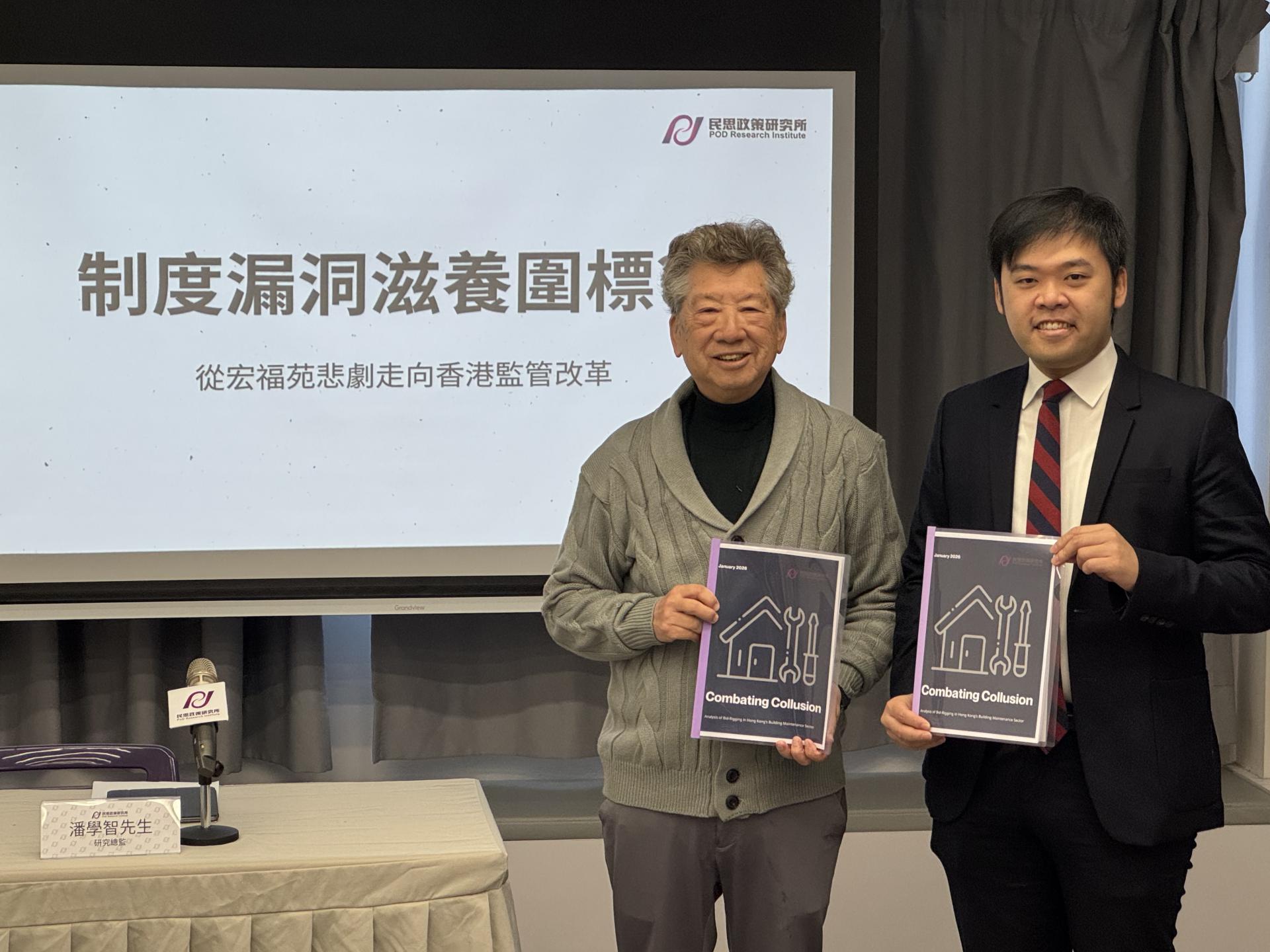
POD Research Institute (PODRI) today released a new research report titled "Combating Collusion: An Analysis of Bid-Rigging in Hong Kong’s Building Maintenance Sector and Lessons from the Wang Fuk Court Fire". The report provides an in-depth analysis of the systemic bid-rigging and corruption problems that have long plagued Hong Kong's building maintenance and repair industry. It concludes that these issues not only cause massive financial losses but also erode property values, undermine public trust, and pose a significant threat to public safety. By comparing international experiences, the report sharply points out that Hong Kong's current prevention and control system is mired in "institutional failure." It proposes a comprehensive reform strategy encompassing technology application, government intervention, financial tools, and civic participation, calling for a fundamental paradigm shift.
Rampant Bid-Rigging Networks and Systemic Shortcomings Fuel Public Safety Crisis
The report examines several representative cases, including a luxury housing estate repair case involving approximately HK$200 million, an old building case where members of the owners' incorporation were bribed with about HK$50 million, and a bid-rigging syndicate case controlling multiple estates involving tens of millions of dollars. These cases clearly reveal how organized crime distorts market competition through collusive quoting, bribery, and intimidation, leading to inflated repair costs, substandard workmanship, and ultimately leaving homeowners to bear all losses and safety risks. The study emphasizes that the recent tragic Wang Fuk Court fire serves as a painful warning of the severe public safety consequences that can arise from such systemic governance failures.
International Positioning: Hong Kong's Outdated Control System in "Institutional Failure"
Mr. Ray Poon, Research Director at PODRI, stated that the study places Hong Kong's current situation within an international context, revealing a severe gap compared to global advanced economies.
Tier | Classification | Representative Jurisdictions | Core Characteristics / Status |
First | Comprehensive Leaders & Efficient Enforcers | South Korea, Singapore | Possess robust, efficient, and integrated systems combining strict laws, powerful independent authorities, strong deterrence (e.g., high fines, criminalization), proactive leniency policies, and advanced technological prevention (e-procurement). |
Second | Exemplars in Specific Fields & Key Inspirations | Japan, Malaysia | Showcase significant success in specific areas such as criminalization of bid-rigging (Japan) or building integrated legal frameworks against corruption and collusion (Malaysia). Provide important lessons for focused reforms. |
Third | Exploring Amid Challenges & Highlights in Community Engagement | Indonesia, Philippines | Have established legal and technological frameworks but face profound, systemic challenges like entrenched corruption. Their experience underscores the importance of combating deep-seated governance issues and the potential role of civil society oversight. |
The report notes that first-tier economies like South Korea and Singapore have established comprehensive prevention systems combining strict regulations, independent authorities, and advanced technology. In contrast, Hong Kong's legal framework contains significant loopholes (e.g., the Competition Ordinance applies only to civil matters, and the Prevention of Bribery Ordinance has limited scope), enforcement resources and technological applications are insufficient, and the problem is closely linked to organized crime, deepening the crisis. The report concludes that bid-rigging and corruption in Hong Kong's building maintenance sector constitute a unique category of "institutional failure and urgent reform," necessitating fundamental change.
Comprehensive Reform Strategy: Advocacy for Six Core Measures to Achieve Industry Paradigm Shift
To address this deep-seated crisis, the study proposes an integrated strategy that moves beyond reactive law enforcement, aiming to dismantle bid-rigging networks at their source, protect homeowners' rights, and rebuild social trust. The core policy recommendations include:
- Strengthening the Legal Framework to Enhance Deterrence: Introduce criminal liability for serious offenses, establish clear legal definitions, and impose stricter penalties. Amend Section 6 and Section 9 of the Prevention of Bribery Ordinance to explicitly define terms such as "agent." Actively promote a "leniency policy" to significantly increase the costs of illegal activities and the risk of detection, thereby addressing unlawful motivations at their source.
- 2. Establish a "Digital Building Passport" and Blockchain Tender Platform: Create a digital record for a building's entire lifecycle and use blockchain technology to ensure tender process data is immutable and fully transparent, technically preventing data fraud and collusion.
- 3. Implement Government-Assisted Tender and Contract Management Services: Set up a dedicated government unit to provide professional tender process assistance and engineering contract management services for resource-limited old building owners' incorporations, addressing their lack of expertise and experience.
- 4. Create a "Unified Maintenance Fund with Governance Oversight": Provide financial support through an established fund. When an owners' incorporation receives significant funding, a proportional share of voting rights on tender, contractor selection, and works supervision would be exercised by a designated government entity or its representative, introducing a fair expert perspective to counterbalance bid-rigging influences.
- 5. Develop an "Artificial Intelligence Bid-Rigging Risk Alert System": Integrate multi-source data and use AI to proactively analyze and identify suspicious bidding patterns across projects and contractors. The system would issue alerts to enforcement agencies like the Competition Commission and the ICAC, shifting from passive investigation to active prevention.
- 6. Launch an "Empowered Resident Petition Mechanism and Citizen Auditor Program": Encourage resident participation in oversight. Simultaneously, train community volunteers as "Citizen Auditors" to assist owners in reviewing project quotations and quality, transforming residents into active community guardians.
The report concludes that solving the bid-rigging and corruption problem in the building maintenance industry is not only an administrative or legal challenge but also a moral imperative to safeguard the security of Hong Kong's homes, community trust, and the integrity of urban infrastructure. Existing piecemeal measures have proven inadequate to address this systemic crisis. Criminalization is a quick and effective measure. At the same time, the SAR government must work hand in hand with the citizens to integrate and actively reform strategies in order to fundamentally restore the system and safeguard the property and life safety of the citizens.
For the full report, please visit: https://podresearch.hk/zh-hk/occasional-papers
For media enquiries, please contact PODRI at 2509 3131.
 Back
Back