 EN
EN Login
Login Donation

【Press Release】- Updated
September 15, 2025
One Country, Two Systems Index Rises Slightly,
Legislative Council Approval Plummets, English Confidence Polarized
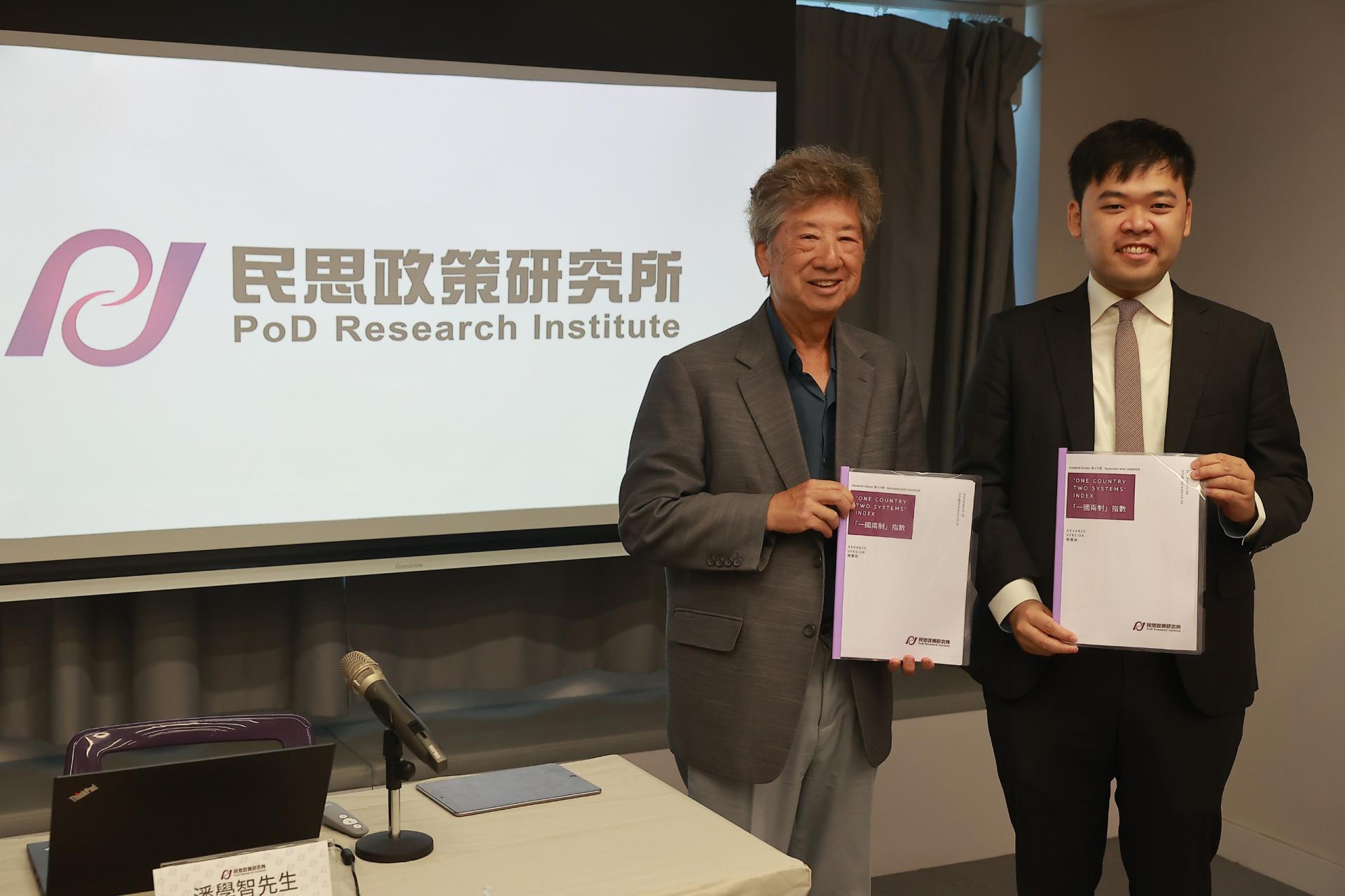
PoD Research Institute (formerly known as “Path of Democracy”) announced the latest "One Country, Two Systems" Index today (September 15), recording a score of 6.15, a modest increase of 0.16% compared to the previous round. This index is an objective evaluation of the status of "One Country, Two Systems," compiled from local public opinion surveys and international assessments, consisting of 6 pillars and 24 sub-pillars.
One Country, Two Systems Index: Slight Rise Amid Local and International Complexities
The survey reveals that among the three pillars of local opinion, "High Degree of Autonomy" saw a slight increase of 0.2%, while "Human Rights and Freedoms" experienced the largest decline, dropping 1.9% to 5.24. "Mainland-Hong Kong Relations" also fell by 0.9% to 5.55. All 12 sub-pillars in this round showed fluctuations, with the largest declines in "Original Ways of Life" (-4.1%), followed by "Equal Protection of the Law" (-2.6%), "Hong Kong People Administrating Hong Kong" (-1.7%), and "Maintaining Long-Term Prosperity and Stability" (-1.7%).
In international evaluations, compared to the previous round, the "Economic Openness" pillar rose by 0.9% to 9.47, and "Civil Liberty " increased by 1.1% to 6.29. The "Democratic Development" pillar saw a 1.4% rise to 5.12. All sub-pillar scores showed an upward trend except for "Expression, Association, and Assembly." Among them, the sub-pillar with the largest increase was "Political Pluralism" (+3.1%).
Ray Poon, Research Director at PoD Research Institute, commented: "The latest 'One Country, Two Systems' Index indicates a slight overall increase in its score, yet the ‘Human Rights and Freedoms’ pillar in local public opinion survey continues to decline, reflecting public concerns over the impact of past political tensions. In contrast, international evaluations present a positive outlook, with multiple pillars showing gains, highlighting Hong Kong’s role as a ‘safe habour’ for international capital amid global security uncertainties. Concurrently, Hong Kong’s institutional competitiveness has significantly improved, with sustained foreign investment confidence, record-high financial inflows, and numerous multinational corporations establishing regional headquarters here. This has driven Hong Kong’s climb of four places in global competitiveness rankings over the past two years, re-entering the top three, with government efficiency and business efficiency each ranking second globally. Overall, the index underscores the complexity of balancing local sentiments with international perceptions, emphasizing the need to maintain national security while safeguarding civil rights.
Legislative Council’s Failure to Improve Public Perception Drives Ongoing Satisfaction Decline
The survey indicates that only 40.3% of respondents are "satisfied" with the SAR government, a 2-percentage-point drop from the previous round, while dissatisfaction rose to 45.1%. The net satisfaction score is -4.8%, reflecting a slight deterioration in public perception of government performance. The Legislative Council’s net satisfaction score fell from -18.7% to -21.0%, indicating growing negative sentiment and increasing public concerns about its operational efficiency and quality of deliberation.
With the 2026 Legislative Election approaching, public expectations for representatives are rising, with calls for the Legislative Council to better reflect public opinion and propose constructive solutions. The current decline in satisfaction serves as a warning to incumbent legislators, who may face heightened accountability pressures in the upcoming election.
When asked about the slight decline in public satisfaction with the HKSAR government, Ronny Tong reiterated that the timing of the relevant opinion survey has its limitations. He specifically noted that the survey was conducted in June of this year and suggested that the lower satisfaction levels may be associated with widespread public discussions at that time regarding the water quality incidents at Queen's Hill Estate, as well as the overall economic downturn and reduced consumer confidence.
Polarized Confidence in English-Speaking Ability in Hong Kong
For the first time, the survey included evaluation of Hong Kong Residents' English-Speaking Proficiency. Results show that 40.5% of respondents feel "confident" in their English oral skills, while 40.1% feel "not confident," with the two groups nearly evenly split. Additionally, 18.2% of respondents indicated a neutral stance ("half - half"). The average confidence score is 4.79 (on a 1–10 scale), slightly below the midpoint.
These findings reveal significant polarization in Hong Kong’s confidence in English oral proficiency, with overall performance relatively weak. Mr. Ronny Tong, Head of PoD Research Institute, emphasized that, as an international financial and commercial hub, Hong Kong must enhance its English communication skills, particularly oral expression, to remain competitive globally. Strengthening practical English-language environments and implementing targeted language-improvement programs for different age and professional groups would boost public confidence and international competitiveness, further solidifying Hong Kong’s status as a global hub. By effectively telling Hong Kong’s story well, enhanced language skills and confidence can better showcase the city’s diverse culture and global perspective.
For the full report and survey results, please visit: https://podresearch.hk
Notes:
1. The local public opinion telephone survey (landline and mobile) was conducted by the Hong Kong Institute of Asia-Pacific Studies at The Chinese University of Hong Kong from June 6 to June 23, 2025. The survey randomly sampled 1,003 Hong Kong residents aged 18 or older, with a landline response rate of 27.2%, a mobile response rate of 72.8%, and a sampling error of ±3.09%.
2. The international assessment scores were collected from long-term tracking indices compiled by nine international think tanks, encompassing 127 indicators and evaluating and ranking 148 countries and regions.
3. Historical data has been uploaded to the online data platform; please refer to: https://podresearch.hk
 Back
Back